PTFE Envelope Gaskets

Key Features
- Excellent resistance to aggressive chemicals and corrosive media
- Combines PTFE chemical protection with a compressible insert
- Helps accommodate minor flange surface irregularities
- Low-friction, non-stick PTFE sealing surface
- Selected gasket constructions suitable for temperatures up to +250°C
- Available with different gasket insert materials
- Food-contact compliant grades available
- Standard and bespoke flange sizes and profiles available

Product Description
Our PTFE envelope gaskets provide a reliable sealing solution for chemical processing, industrial pipework and equipment exposed to aggressive or corrosive media. Combining the excellent chemical resistance of PTFE with the compressibility and mechanical strength of an internal gasket insert, these composite seals offer effective protection in demanding operating environments.
Each gasket features a chemically resistant PTFE outer envelope surrounding a compressible inner core. The PTFE layer protects the insert from direct contact with process fluids, while the internal material helps accommodate minor flange surface irregularities and maintain an effective seal under compression.
Also known as PTFE jacketed gaskets, PTFE-sheathed gaskets or encapsulated gaskets, these seals are particularly suitable for glass-lined equipment, chemical processing systems, reactor vessels and industrial flanges. Selected grades can operate at temperatures up to +250°C, subject to the insert material, pressure and application requirements. We also supply a comprehensive range of flange gaskets for general industrial sealing requirements..
We supply PTFE envelope gaskets in a range of standard flange sizes and bespoke configurations, including full-face, ring and specialist profiles. Custom gaskets can be manufactured to suit technical drawings, flange specifications or existing samples.
PTFE Envelope Gasket Construction
PTFE envelope gaskets combine a chemically resistant PTFE outer covering with a compressible internal gasket insert. The PTFE envelope forms the process-facing sealing surface, while the insert provides the compression and mechanical support required for effective flange sealing. Depending on the construction, the outer edge of the insert may remain exposed.
The PTFE envelope provides the primary contact surface for aggressive process fluids, helping protect the inner material from chemical attack. The internal insert supplies the compressibility and resilience required to establish an effective seal between flange surfaces.
Common insert materials include:
- Compressed Fibre: Provides mechanical strength and compressibility for general industrial flange sealing.
- EPDM Rubber: Offers flexibility and resilience for compatible process conditions.
- FKM Rubber: Suitable for selected applications requiring increased temperature and chemical resistance.
- Graphite: Provides thermal stability for demanding industrial sealing applications, subject to the gasket design.
The most suitable construction depends on the process media, operating temperature, pressure, flange condition and required sealing performance.
Types of PTFE Envelope Gaskets
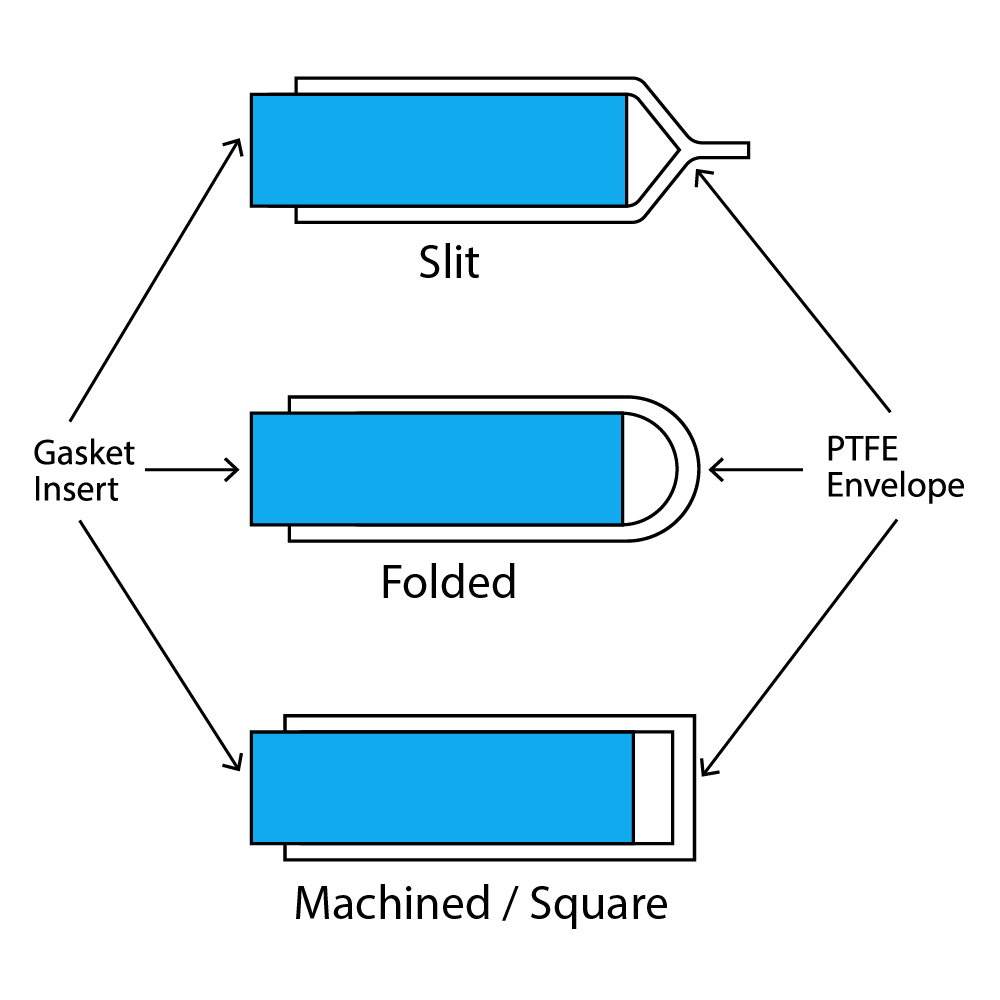
PTFE envelope gaskets are available in different constructions to suit a wide range of flange configurations, operating conditions and sealing requirements. The three main designs are slit, machined and folded tape envelopes, although terminology can vary between manufacturers.
Slit / Fin Type PTFE Envelope Gaskets
A cost-effective design manufactured by cutting a slit into a PTFE ring from the outside edge to accommodate the gasket insert. Commonly used for standard industrial flange applications where the process conditions are suitable.
Machined / Square Section PTFE Envelope Gaskets
Precision-machined from solid PTFE material to create a defined cavity for the internal insert. This construction provides a controlled internal profile and is particularly suitable where accurate dimensions, restricted sealing widths or a smooth transition through the pipe bore are required.
Folded / Welded Tape PTFE Envelope Gaskets
This construction uses PTFE tape that is formed around a compressible gasket insert to create a protective envelope. The PTFE covering is secured using a joining method appropriate to the design, which may include welding. This type is particularly suitable for larger diameter gaskets and bespoke applications where alternative envelope constructions may be less practical.
Alternative envelope designs, including full-face, double-envelope and specialist profiles, may also be available to suit individual sealing requirements. The most suitable construction depends on the flange dimensions, process media, operating temperature, pressure and insert material.
Chemical Resistance & Sealing Performance
PTFE provides excellent resistance to a wide range of acids, alkalis, solvents and aggressive industrial chemicals, making PTFE envelope gaskets particularly suitable for applications where conventional elastomeric or fibre gaskets may be unsuitable.
The low-friction, non-stick PTFE surface also helps reduce material adhesion and contamination risks in compatible processing environments.
Unlike solid PTFE gaskets, the composite envelope construction incorporates a compressible insert to improve conformity to flange surfaces. This can be particularly beneficial for glass-lined equipment and other applications where controlled compression and reliable sealing are important.
Chemical compatibility, temperature limits and pressure suitability must be assessed for the complete gasket assembly, including the envelope, insert and flange arrangement.
Bespoke PTFE Envelope Gasket Manufacturing
We supply custom PTFE envelope gaskets to suit a wide range of industrial flange configurations, including standard ring gaskets, full-face designs and specialist profiles.
Gaskets can be specified using flange standards, technical drawings, CAD files or existing samples. Different envelope constructions and insert materials are available to meet individual chemical compatibility, dimensional and operating requirements.
Contact our team with your required gasket dimensions, flange specification, process media, operating temperature and pressure to discuss a suitable sealing solution.
For applications requiring a solid PTFE gasket rather than a composite envelope construction, explore our range of PTFE gaskets.
FAQs
A PTFE envelope gasket combines a chemically resistant PTFE outer layer with a compressible internal insert. A solid PTFE gasket is manufactured entirely from PTFE or a PTFE-based compound. The envelope construction provides additional compressibility through the insert.
Common insert materials include compressed fibre, EPDM rubber, FKM rubber and graphite. The correct insert depends on the operating temperature, pressure, flange arrangement and sealing requirements.
Yes. PTFE envelope gaskets can be supplied in standard flange dimensions and custom sizes, including large-diameter, full-face and specialist profiles. Availability depends on the envelope construction and manufacturing requirements.
Potential Applications
- Chemical and petrochemical processing equipment
- Glass-lined pipework and flange connections
- Reactor vessels and distillation columns
- Pharmaceutical and biotechnology processing
- Food and beverage production equipment
- Pumps, valves and industrial piping systems
- Corrosive fluid handling and storage equipment
- Industrial process vessels and filtration systems